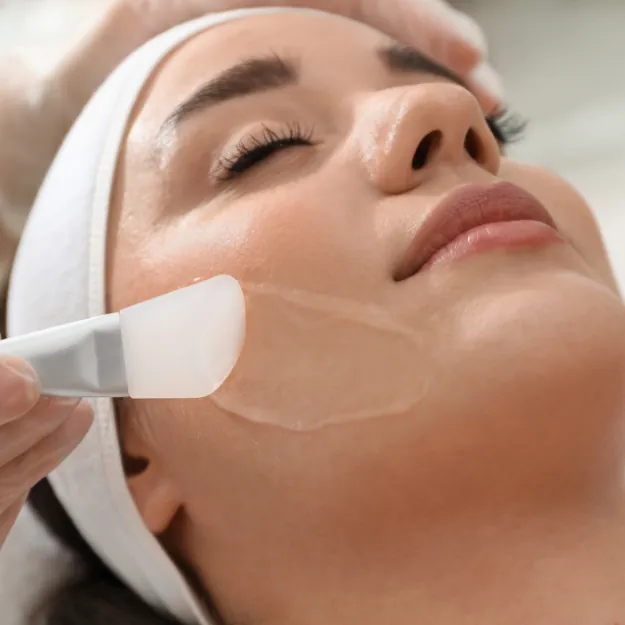
Peeling refers to a cosmetic treatment that uses a chemical solution to improve and smooth the texture of facial skin by removing its damaged outer layers. It is used to treat a variety of skin concerns, including:* **Acne and acne scars:** Peeling can help to unclog pores and reduce the appearance of acne. It can also improve the texture of the skin and reduce the visibility of acne scars.
* **Hyperpigmentation:** This includes things like sun spots, age spots, melasma, and post-inflammatory hyperpigmentation. Peeling can help to break down and remove excess pigment.
* **Fine lines and wrinkles:** By removing the outer layers of damaged skin, peeling can stimulate the production of new, healthier skin cells, which can reduce the appearance of fine lines and wrinkles.
* **Uneven skin tone and texture:** Peeling can help to create a more uniform and smoother complexion.
* **Sun damage:** Peeling can help to reverse some of the effects of sun exposure, such as roughness and discolouration.Peels vary in strength, from superficial peels that only affect the outermost layer of skin to deeper peels that penetrate further. The type of peel recommended will depend on the individual's skin concerns and desired results.
What is a facial peel?
It is a medical-aesthetic treatment that applies an exfoliating active ingredient (an acid or keratolytic) to the skin, which removes the outermost layers in a controlled manner and stimulates skin renewal. Depending on its depth, it can be superficial, medium, or deep, and is always indicated by the doctor according to your skin type.
A chemical peel is used to improve the appearance of the skin.
It is used to renew the skin on your face: it improves blemishes and uneven tone, refines texture, adds radiance, smooths fine lines, and helps with acne and its marks. It is a non-surgical treatment that evens out skin tone and gives it a more youthful appearance.
Does peeling work for blemishes and acne?
Yes. It is one of the benchmark treatments for reducing blemishes and evening out skin tone, and certain peels improve inflammatory acne and smooth its superficial scarring. The active ingredient and depth are chosen according to your type of blemish or acne during the medical assessment.
What is the procedure
Does the peel hurt and does the skin flake off?
It is usually well-tolerated; stinging or heat may be noticed during application. Redness then appears (more intense the deeper the peel) and, from the second or third day, peeling begins, which can last between 7 and 10 days. It is important not to pick at the skin, to moisturise and use sun protection.
How many peeling
It depends on the type of peel and the objective. Superficial peels are usually planned over several spaced sessions to achieve progressive results; a medium or deep peel can achieve more marked changes in fewer sessions. The medical team defines the number and frequency after assessment.
Can you have a peel in the summer?
The ideal time for many peels is between autumn and spring (approximately October to May), when the sun is less intense. In summer, a mild peel can be considered, but always with strict sun protection and under medical guidance, as sun exposure is the main risk factor for pigmentation.
Price and areas
How much does a facial peel cost in Girona?
There isn't a single price: it depends on the type of peel (superficial, medium or deep), the active ingredient, the number of sessions and your goals. The price is personalised after a free, no-obligation medical assessment. You can also explore financing options.
Do you see patients from outside Girona?
Yes. We regularly receive patients from all over the province of Girona and the Costa Brava (Salt, Figueres, Blanes, Lloret de Mar, Olot, Banyoles, Palafrugell, Sant Feliu de Guíxols...). If you are coming from outside, we coordinate assessment and treatment on the same day whenever possible.