
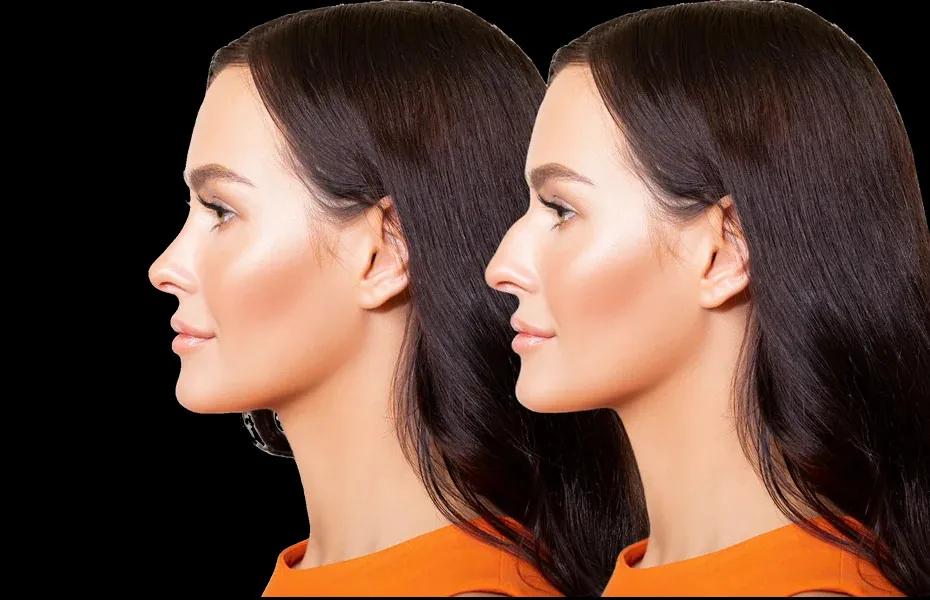
Rhinoplasty recovery photos are useful, but they can also cause anxiety if misinterpreted. Many people see their nose swollen in the first weeks and think something has gone wrong, when in fact they are seeing a completely expected phase of the postoperative period.
The key is to understand that the nose changes a great deal during recovery. First the most obvious swelling goes down. Then the bridge becomes defined. Later the tip begins to refine. And, finally, the tissue finishes adapting.
Why not all photos show the final result
A rhinoplasty photo at day 7, day 15 or one month does not show the final result. It shows a nose in recovery.
During the first few weeks you may see:
- Swelling.
- Moratones.
- Punta nasal redondeada.
- Stiff nose.
- Feeling of asymmetry.
- Nasal dorsum wider than expected.
- Tight skin.
- Changes from one side compared to the other.
This does not necessarily mean the result will end up like that. Swelling can be very deceptive, especially in the nasal tip.
What to look for in a recovery photo
When you look at rhinoplasty recovery photos, pay attention to three things:
- When the photo was taken. An image at 10 days is not the same as one at 6 months.
- Which area is being assessed. The nasal tip usually takes longer than the bridge.
- Whether the photos are comparable. Light, angle, distance and facial expression must be similar.
A good progress photo does not just show the “before and after”; it also explains what stage the patient is at.
Rhinoplasty recovery photos by stages
For visual content to be useful, the ideal is to organise recovery photos by stages. That way the user can understand what is normal at each point.
| Phase | What is usually seen in the photos | How to interpret it |
| Early days | Splint, swelling, bruising | Initial stage, do not judge the result |
| 2 semanas | Fewer bruises, nose still swollen | First visible improvement |
| 1 month | Clear change, but swollen tip | Evolution, not the final result |
| 3 meses | More definition, less swelling | More stable result |
| 6 months | Slimmer tip, clearer profile | Advanced result |
| 12 meses | Much more complete reduction of swelling | Final or almost final result |
Photos from the first days after rhinoplasty
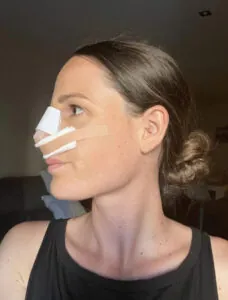
In the first few days, photos usually show the splint, swelling and possible bruising around the eyes. The face may also look more swollen than usual.
This phase is not for judging the aesthetic result. It serves to see how the recovery process begins.
Photos at 2 weeks
At 2 weeks, many people already have less bruising and less overall swelling. However, the nose may still look wide, stiff or poorly defined.
It is a phase where the change is starting to become noticeable, but there is still a long way to go.
Photos one month after rhinoplasty
After a month a significant improvement is usually seen. The face is more recovered, the swelling has gone down considerably and the profile begins to be better appreciated.
But a photo taken one month in should not be mistaken for the final result. At this stage the nose may still look swollen, especially at the tip.
Photos at 3 months
At 3 months there is usually more definition. The bridge looks more stable and the tip begins to lose swelling, although some oedema may still remain.
This stage already lets you see better where the result is heading, but the nose may continue to change.
Photos at 6 months
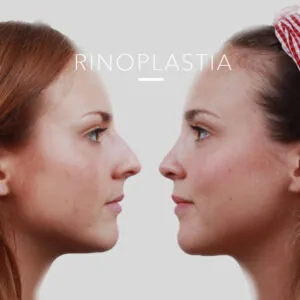
At 6 months, the result is usually much more advanced. The swelling has gone down noticeably and the nose looks more integrated with the face.
Even so, in some patients the nasal tip may continue to refine after this point.
Photos one year after the rhinoplasty
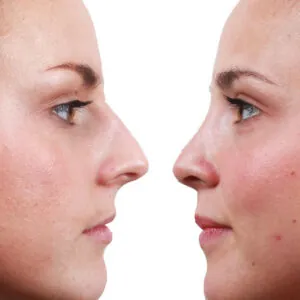
After a year, many rhinoplasties already show a final or very nearly final result. The tip is usually much less swollen and the result looks more natural.
That is why photos taken at one year are usually the most reliable for judging the real before and after.
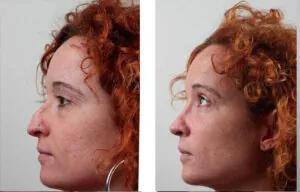
What changes are normal during recovery
During recovery, the nose may go through phases that look odd or worrying. This does not always indicate a problem.
Swelling and bruising
Swelling is normal after a rhinoplasty. Bruising may also appear, especially if the nasal bone has been worked on.
In photos, this can look like:
- Purple or yellowish bruising around the eyes.
- Mejillas hinchadas.
- Dorso nasal ancho.
- Punta poco definida.
- Feeling that the nose is big.
Bruising usually improves before the deep swelling of the nose does.
Punta nasal hinchada
The nasal tip deserves its own section because it is one of the areas that causes the most concern. It is very common for it to still look rounded, hard or bigger than expected at one month.
The tip can take between 6 and 12 months to go down completely. In thicker skin, this process can be even slower.
That is why, if you see recovery photos at one month or at 3 months, you should not draw definitive conclusions about the tip.
Feeling of a stiff or different nose
After a rhinoplasty, the nose may feel stiff, sensitive or strange. This may come with temporary visual changes.
In photos, this stiffness can make the nose look less natural at first. Over time, the tissues adapt and the result usually looks softer.
Rhinoplasty before and after: when to compare results
Before-and-after photos are very useful, but only if they are compared at the right moment.
A common mistake is to compare the nose before surgery with a photo from the first few weeks and think that this will be the final result. It is not.
Why the one-month before and after is not final
At one month, the nose is still recovering. It is true that the most dramatic changes are usually seen during the first 4 weeks, but that does not mean the process is over.
A photo at one month can show:
- Better profile.
- Menos giba.
- Tip with a new shape.
- Less facial swelling.
- Evident changes compared to before.
But it still does not show the final definition of the tip or the complete adaptation of the tissues.
When the final result is best appreciated
The result is best appreciated between 6 and 12 months. During this period, the nose is usually much less swollen and more stable.
To properly compare the before and after, the ideal is to use photos:
- With the same light.
- Mismo fondo.
- Mismo ángulo.
- Misma distancia.
- Misma expresión facial.
- No filters or retouching.
This way the progress can be assessed more honestly.
Nasal tip recovery in photos
The nasal tip is one of the most important areas in a rhinoplasty and also one of the slowest to recover.
Why the tip takes longer to deflate
The nasal tip has skin, cartilage, soft tissue and a blood supply that needs time to recover. In addition, if the tip has been worked on extensively, there may be more local swelling.
In photos, this can make the tip look:
- Redondeada.
- Ancha.
- Elevada.
- Dura.
- Poco definida.
- Temporarily asymmetrical.
This can be normal during the first few months.
Evolution of the tip between 6 and 12 months
Between 6 and 12 months, the tip usually becomes progressively more refined. The swelling goes down slowly and the final shape becomes more evident.
That is why, when someone looks for recovery photos of rhinoplasty Girona, they should pay particular attention to the 6-month and 12-month images if they want to understand the most realistic result.
Natural results and realistic expectations
The best rhinoplasty photos are not the ones that show impossible transformations. They are the ones that show natural, proportionate results that are consistent with each patient's face.
A good gallery should help you understand what can be achieved, but also what should not be promised.
Tips for taking photos during recovery
If someone wants to document their recovery, the ideal is to do it in an orderly way.
Same light, angle and distance
For a proper comparison, photos should always be taken in a similar way:
- Mismo lugar.
- Misma luz.
- Mismo fondo.
- Mismo ángulo.
- Misma distancia.
- Same head position.
This prevents a photo from looking better or worse just because of the lighting or the angle.
Which moments are worth photographing
The most useful moments to take photos are:
- Before the surgery.
- Al retirar la férula.
- At 2 weeks.
- Al mes.
- At 3 months.
- At 6 months.
- At 12 months.
There is no need to look at your nose every day. In fact, doing so can increase anxiety.
Why avoid comparing photos too soon
Comparing too early can lead to wrong conclusions. The nose can change a lot from one week to the next, and it may even look more swollen on some days than on others.
Recovery is not always linear. There are days when the nose looks better and others when it may look more swollen. That does not mean the result has got worse.
Frequently asked questions about rhinoplasty recovery photos
When do the results show in photos?
The first visible changes are usually noticed during the first 4 weeks, but the final result is usually appreciated between 6 and 12 months.
Is it normal for the nose to look swollen after a month?
Yes. At one month there may still be swelling, especially in the tip of the nose. A photo at one month shows progress, not the final result.
When does the nasal tip drop?
The nasal tip can take between 6 and 12 months to go down completely. In some cases, especially with thick skin, it can take longer.
When can I compare the before and after?
You can compare initial changes at one month, but the most reliable before and after is usually judged from 6 months onwards and, better still, at one year.
Do rhinoplasty photos show real results?
It depends on the source. Ideally, they should be real photos, unretouched, with the patient's consent and taken under comparable conditions.
Is it normal to look strange in the first photos?
Yes. The swelling, the splint, the bruising and the stiffness can make your face look different during the first few weeks.
Does every recovery look the same in photos?
No. Recovery depends on the technique, skin type, swelling, post-operative care and each patient’s anatomy.
Which photos are most useful for assessing a rhinoplasty?
The most useful ones show the front, profile and three-quarter views at several points: before, 1 month, 3 months, 6 months and 12 months.