
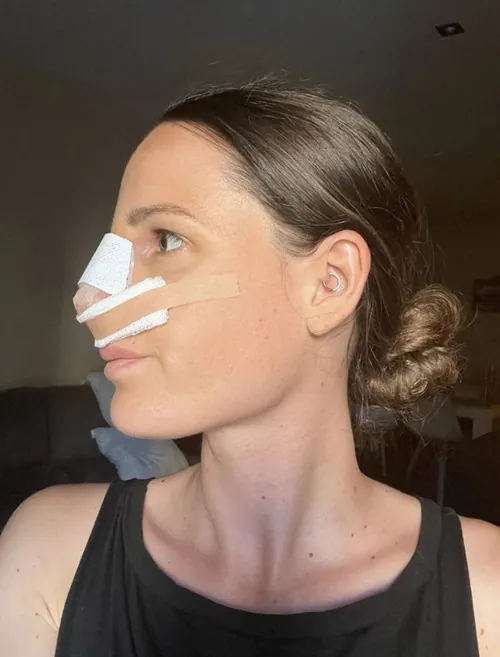
For a good recovery after a rhinoplasty it is advisable to rest, sleep with your head elevated, apply local cold, take the prescribed medication, not blow your nose, keep the incisions clean and avoid sun, tobacco, alcohol and intense exercise in the early phase. Attending follow-up check-ups is part of the treatment.
After a Rhinoplasty it is normal to experience mild pain, swelling, tenderness, nasal congestion and bruising around the eyes during the first few days. The good news is that with proper care you can reduce inflammation, discomfort and the risk of complications, and promote a faster recovery. In this guide we bring together the best postoperative tips: from rest and local cold to incision hygiene, diet and when to resume your activities.
These tips complement your surgeon's instructions, which always take priority. If you are considering surgery or want follow-up, you can visit the unit of Rhinoplasty in Girona.
What to expect during the post-operative period
In the first few days you may feel pain, swelling and tenderness in the operated area, as well as nasal congestion and some difficulty breathing. Bruising around the eyes and nose may also appear, which is common when a precise result is sought. These are normal, expected symptoms that gradually fade as the nose looks more natural and in harmony with the face. The essential thing is to follow the surgeon's instructions: head raised when sleeping, cold compresses, avoiding physical exertion and taking the prescribed medication.
Care for immediate recovery (steps)
- Get enough rest: plan a few days off and sleep well so that the body recovers.
- Apply cold compresses: they reduce swelling and bruising; use ice or a cold gel pack wrapped in a towel so as not to burn the skin.
- Elevate your head: sleep with extra pillows or in a reclining chair to reduce swelling.
- Take the medication as prescribed to control pain and swelling.
- Avoid smoking and drinking alcohol: they can delay healing and increase the risk of complications.
- Avoid sun exposure for at least six weeks; use sun protection and a hat if necessary.
- Avoid strenuous activities and heavy lifting for at least two weeks, as well as contact sports that could harm the nose.
How to care for your nose and incisions
Keep the area clean: gently clean with saline solution or according to the surgeon’s instructions, and do not blow your nose hard for at least two weeks. Keep the incisions clean and dry, washing them with mild soap and water and drying them carefully; avoid getting them wet whenever possible and do not touch or rub your nose, so as not to spread germs. Always follow your surgeon’s specific instructions for caring for the area.
How to reduce swelling and bruising
In addition to general care, these measures can help reduce swelling:
- Arnica compresses: it has anti-inflammatory properties; ask your surgeon if you can use them and how to apply them.
- Avoid salty foods: they increase fluid retention and can contribute to swelling.
- Sleep with your head elevated and apply cold compresses to the nose and eyes.
- Bromelain supplements (an anti-inflammatory enzyme from pineapple): check with your doctor before taking them.
How to deal with pain
Some pain and discomfort in the nose and face area is normal. To manage it:
- Pain medication prescribed by your surgeon (e.g. paracetamol or ibuprofen); follow the dosage and do not take more than indicated.
- Ice therapy: an ice pack wrapped in a towel, about 20 minutes several times a day.
- Elevation of the head above heart level when sleeping.
- Deep breathing and relaxation to reduce tension.
For a complete overview of the post-operative phases, see the guide to Rhinoplasty recovery.
Long-term care: hygiene and diet
Keep the area clean and dry, avoid touching your nose or rubbing the incisions, and protect your skin from the sun. Follow a healthy, balanced diet, avoid spicy and very hot foods (they can irritate the area) and limit alcohol and tobacco, which slow healing. Attend the follow-up visits: at Medics Integral Salut we provide follow-up during the 12 months after the procedure, which allows us to monitor your progress and answer any questions.
When to return to your activities
| Activity | Usual guidance |
|---|---|
| Trabajo o estudios | Depending on the type of activity, a week or more of rest is usually needed; check with your surgeon |
| Intense physical activity | Avoid vigorous exercise, weights and sports for at least a month |
| Conducir | Wait at least a week; pain and discomfort make it hard to concentrate |
| Viajar en avión | Wait at least two weeks; air pressure can affect healing |
Allowing your body to recover properly is the best way to return to Rhinoplasty in Girona safely and without complications.
Recovery step by step: what to expect week by week
Knowing what is normal at each stage helps you go through the postoperative period with greater peace of mind and tell the expected progress apart from a warning sign. These are the usual milestones, always approximate and secondary to whatever your surgeon tells you:
| Moment | What usually happens |
|---|---|
| First 2-3 days | Maximum swelling and bruising around the eyes, congestion and discomfort; rest, local cold and head elevated |
| Day 6-7 | Usual removal of the splint and, if you have them, external stitches, as medically indicated |
| 1-2 semanas | Bruising goes down; gradual return to social life and non-physical work |
| 3-6 semanas | Gradual reintroduction of sport; intense exercise and contact sports are avoided |
| 3-12 meses | The residual swelling keeps going down, especially in the tip, until the final result |
It is completely normal for the nose to stay somewhat swollen for weeks and does not mean the result is poor: the tissue needs time to settle. You can see the full phase-by-phase detail in the guide to Rhinoplasty recovery.
How to sleep, blow your nose, eat and exercise
Four questions account for most postoperative inquiries. It's worth having them clear:
- How to sleep on your back with your Head held high on several pillows during the first few weeks. Sleeping upright reduces swelling and avoids pressure on your nose; try not to sleep on your side or face down.
- Blowing your nose: do not blow hard for at least the first few weeks, because it can cause bleeding and displace structures that are still fragile. For congestion, use saline solution as instructed and sneeze with your mouth open.
- What to eat: for the first few days, a soft diet at a lukewarm or cold temperature if chewing is uncomfortable, and plenty of fluids. Avoid very hot foods, very salty foods (they promote fluid retention) or foods that require large facial movements.
- When to exercise: light activity is resumed soon, but intense exercise, weights and contact sports are usually postponed until 3-6 weeks as indicated by the doctor, so as not to compromise the result or cause bleeding.
Fibrosis and bone callus: what they are and how to know if they appear
Two terms that raise questions in the postoperative period are fibrosis and bony callus. Fibrosis is a thickening of the scar tissue under the skin, especially in the tip and in thick skin; it can feel like a harder, swollen or poorly defined area during the first few months and, in most cases, is reabsorbed over time or improves with massage and the treatments indicated by the surgeon. Bony callus is a small formation of new bone in the remodelled area of the bridge, which can be perceived as a bump or irregularity when you run a finger over it; it is usually mild and, if it is visible or bothersome, a touch-up can be considered once the result has stabilised. How do you know if they appear? By a hardened area, a bump that does not go down along with the rest of the swelling, or an asymmetry that persists after several months. The right thing to do is to mention it at your check-up: only an examination can distinguish a normal fibrosis from an irregularity that should be treated.
Complications to watch for and warning signs
The vast majority of rhinoplasties progress without complications, but it is worth knowing which symptoms are within the normal range and which are not. The following are expected: mild or moderate pain that can be controlled with the prescribed medication, swelling, bruising around the eyes, nasal congestion and slight discharge or pink staining during the first few days. On the other hand, there are signs that you should not simply put down to the postoperative period and that should be monitored closely.
- Heavy bleeding or bleeding that does not stop with the head elevated and a few minutes of rest.
- Fever (for example, above 38 ºC), chills or general malaise, which may indicate infection.
- Severe pain that increases over the days instead of decreasing, or that does not subside with the prescribed medication.
- Increasing redness, heat, pus or a bad smell in the area of the incisions.
- Very asymmetric swelling or swelling that suddenly gets worse, instead of improving progressively.
- Significant difficulty breathing, chest pain or leg pain, which require immediate attention.
When should you call the doctor?
If you notice any of the above signs — or simply if something worries you and you are not sure whether it is normal — the right thing to do is to contact your medical team without waiting for your next check-up. It is better to make one consultation too many than to overlook a warning sign: many complications are easily resolved if detected in time. At Medics Integral Salut we provide follow-up for the 12 months after the procedure, with scheduled check-ups to monitor progress, remove the splint, assess healing and answer questions; and in an emergency you can write to us on WhatsApp or call us by phone. Remember that this advice is for guidance only and does not replace the personalised instructions of your surgeon, which always take priority. If you are still considering surgery or want close follow-up, you can learn about the rhinoplasty unit in Girona.
Summary of care for a good postoperative recovery
If you had to keep just the essentials after a rhinoplasty:
- Head elevated when sleeping and local cold for the inflammation.
- Do not blow your nose hard or touch the incisions or the splint.
- No sun, tobacco, alcohol or intense exercise in the initial phase.
- Attend your check-ups and report any warning sign.
If you have any doubts or any symptom that worries you, contact the medical team. Get your questions answered by our team →
Resolve your case with the medical team
First consultation for aesthetic and functional nose surgery, in Girona.
Related video
Ultrasonic rhinoplasty in Girona: precision and recovery · Watch on our YouTube channel
Frequently asked questions
How should I sleep after a rhinoplasty?
Can I apply cold to my nose?
When can I sunbathe after a rhinoplasty?
Do arnica or bromelain help reduce swelling?
When can I drive or fly?
How long does postoperative follow-up last?
Can I blow my nose after rhinoplasty?
What should I eat during the postoperative period?
When can I return to sports after a rhinoplasty?
How long do bruises and swelling take to disappear?
What are fibrosis and bony callus and how can you tell if they appear?
What warning signs should I watch for after a rhinoplasty?
When should I call the doctor?
When is the final result of rhinoplasty visible?
Treatments and related units
Explore the treatments for Facial Cosmetic Surgery Unit and other areas of the clinic. Filter by area:
Rhinoplasty in Girona
Aesthetic and functional nose surgery, also with the ultrasonic technique.
Neck and jowl mini lift
Neck and double chin treatment with less surgical aggression.
Related articles


We serve patients from all over the province of Girona
Our clinic is located in the centre of Girona (Plaça Poeta Marquina, 3) and we regularly see patients from the city and the entire surrounding area and the Costa Brava. If you are coming from further afield, we coordinate appointments to group assessments and tests on the same day.
Plaça Poeta Marquina, 3, 17002 Girona · easy access from the AP-7 and N-II · How to get there and opening times
Medical review Content created by the medical team at Medics Integral Salut and reviewed by the Facial Aesthetic Surgery Unit.
Sources and references: Spanish Society of Plastic, Reconstructive and Aesthetic Surgery (SECPRE) · Spanish Society of Otorhinolaryngology and Head and Neck Surgery (SEORL-CCC).