
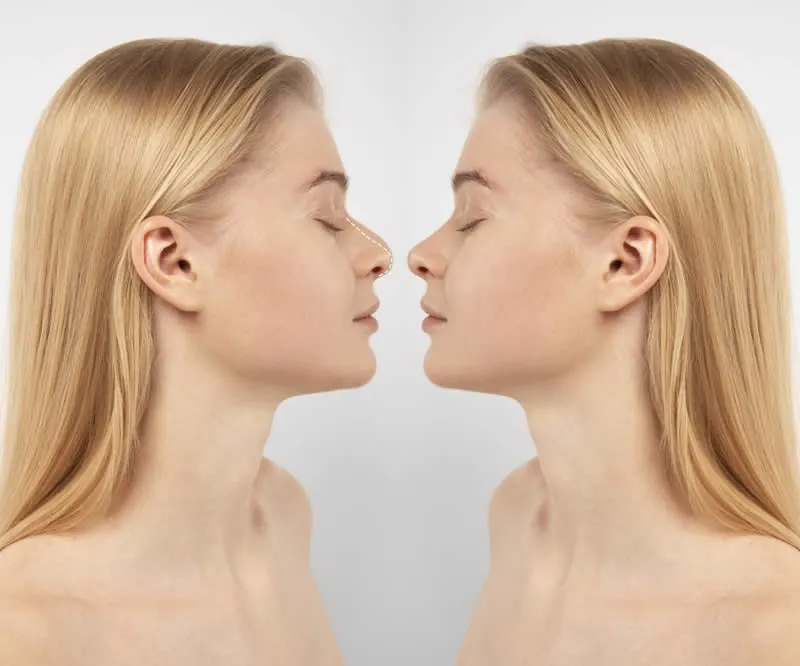
Rhinoplasty is a surgical procedure that changes the shape, size or structure of the nose (bone, cartilage, tip, bridge and septum). It can be cosmetic, functional (improving breathing) or both. It is performed under anesthesia, a splint is worn for the first few days and the final result takes months to appear. It is surgery: it requires an individual medical consultation, planning and realistic expectations.
Rhinoplasty is one of the most requested facial surgeries, but also one of the most demanding: the nose is at the centre of the face and a small change can alter the profile a great deal. It is not always about “making the nose prettier”; in many cases it also seeks to improve breathing, repair the after-effects of trauma or correct congenital alterations. In this guide we explain what it is, what it is for, how it is done, what types exist, how long recovery lasts, what risks it carries and what the difference is with septoplasty.
At Medics Integral Salut we approach Rhinoplasty in Girona through a personalised consultation that takes into account both aesthetics and breathing function, because a nose must look balanced with the face and, above all, breathe well.
Rhinoplasty: what is it?
Rhinoplasty is a nose surgery that makes it possible to change its external shape, size, internal structure or breathing function. It can be performed to correct a nasal hump, refine the tip, reduce asymmetries, improve the facial profile, repair damage from blows or treat problems that make breathing difficult. Put simply: rhinoplasty changes the nose from a cosmetic point of view, a functional one, or both. The procedure usually lasts between one and three hours, depending on the complexity of the case.
Simple definition and goals
A rhinoplasty is a surgical procedure that changes the shape, size and structure of the nose to improve its appearance, its breathing function or both. It sums up three main goals:
- Aesthetic goal: to improve the shape, proportion or harmony of the nose.
- Functional goal: to improve breathing or correct internal alterations.
- Reconstructive goal: to repair sequelae of injuries, previous surgeries or malformations.
It is not only about reducing the size. In some cases a hump is removed, in others a deviation is corrected, the tip is redefined, the nostrils are narrowed or the internal support is improved to breathe better.
Cosmetic surgery versus functional surgery
Cosmetic rhinoplasty seeks to improve appearance: a drooping tip, a very projected nose, a visible hump, an asymmetry or a shape that does not harmonise with the face. Functional rhinoplasty focuses on improving breathing when there is nasal obstruction, structural alterations, after-effects of trauma or septum problems. In practice, many rhinoplasties are mixed: that is why the prior assessment is so important.
What a rhinoplasty is for
The nose is not just a visible part of the face: it also performs an essential respiratory function. That is why, before considering surgery, the specialist assesses both the external appearance and the internal structure.
Correcting shape, size and facial harmony
One of the most common reasons is to change the shape or size: reducing a large nose, correcting a crooked nose, improving the profile, softening the bridge or adjusting the proportion between nose, forehead, lips and chin. A key concept comes into play here: facial harmony. The best rhinoplasty is not the most obvious one, but the one that makes the nose fit better with the rest of the face.
Refining the tip or reducing a hump
On the aesthetic side, it usually corrects specific details such as a nasal hump, a wide, drooping or poorly defined tip, asymmetries or very open nostrils. It is not advisable to promise a nose identical to a reference photo: each face has different proportions and each nose its own anatomy.
Improve breathing or repair injuries
It can also have a functional purpose when there is breathing difficulty, sequelae of fractures, structural deviations, congenital problems, septal alterations or nasal valve collapse. When the main problem lies in the septum, a septoplasty may be necessary; and when aesthetic and functional correction are combined, it is called Rhinoseptoplasty.
Tipos de rinoplastia
There is no single way of operating on the nose. The technique depends on the goal, the anatomy, the thickness of the skin, the condition of the cartilage, respiratory function and whether the person has been operated on before.
| Type | What does it consist of | When it is usually indicated |
|---|---|---|
| Aesthetic rhinoplasty | Modifies the dorsum, tip, width, projection or external symmetry | Reduce the hump, refine the tip, correct the deviation, improve the profile |
| Rinoplastia funcional | Improves breathing; can act on the septum, valves or turbinates | Nasal obstruction or internal alterations that make breathing difficult |
| Rinoplastia abierta | Small incision on the columella; greater visualization of the structures | Complex cases or those requiring great precision on the tip |
| Rinoplastia cerrada | Incisions inside the nose, with no visible external scar | Cases with less need for exposure |
| Ultrasonic rhinoplasty | Works on the bone with an ultrasound device (piezotome) | When the bone of the dorsum needs to be reshaped with millimetre precision |
| Secundaria / reconstructiva | Corrects or repairs a nose that has already been operated on or has a previous deformity | Touch-ups after previous surgery, sequelae of trauma or malformations |
No technique is "best" for everyone. The choice depends on the case and the surgeon's judgement. To learn more about the bone technique, see Ultrasonic rhinoplasty.
Open rhinoplasty and closed rhinoplasty: how do they differ?
It is one of the first questions that comes up when researching. In closed rhinoplasty all incisions are made inside the nose, so no visible external scar remains; it is usually reserved for more limited changes and allows somewhat more contained swelling in some cases. In open rhinoplasty a small incision is added in the columella — the strip of skin separating the two nostrils — which allows the surgeon to lift the skin and work with direct vision of the structures. This greater exposure is very useful in complex noses, in delicate work on the tip and in revision surgeries. The columella scar usually becomes almost imperceptible over time. There is no universally superior technique: the choice depends on what needs correcting and the specialist's judgement.
Ultrasonic rhinoplasty: what it offers
Ultrasound rhinoplasty (or piezoelectric) uses an ultrasound device that remodels and sculpts the bone of the dorsum with great precision, better respecting the surrounding soft tissues (mucosa, vessels and cartilage). In practice, this can mean less bruising and less swelling in some patients and very fine control over the shape of the bone. It does not replace the assessment or make a complex surgery trivial: it is one more tool, especially valuable when a hump has to be reduced or the bony pyramid narrowed accurately. You can read more in Ultrasonic rhinoplasty.
Secondary or revision rhinoplasty: when it is considered
Secondary rhinoplasty —also called revision rhinoplasty— is performed on a nose that has already been operated on, when the previous result did not meet expectations, an asymmetry or irregularity remained, a breathing difficulty appeared or the patient wants to refine some detail. It is technically more demanding than a first surgery: the tissues are scarred, the anatomy may be altered and sometimes cartilage needs to be added (from the patient's own septum, ear or rib) to rebuild support. That is why it is advisable to wait until the nose is completely free of swelling —usually at least one year after the previous surgery— before considering a revision, and to choose a surgeon with specific experience in this type of case. Not every postoperative irregularity requires another operation: many resolve with time, massage or minor treatments.
Rhinoplasty or non-surgical nose reshaping: which is better
Alongside surgery there is Rhinomodelling, or rhinoplasty without surgery, a facial aesthetic medicine technique that, using filler materials (usually hyaluronic acid), disguises small irregularities of the nasal dorsum or slightly projects the tip without going into the operating theatre. It is a very frequently searched question: which is better, rhinoplasty or rhinomodelling? The honest answer is that they do not compete, because they solve different problems.
| Appearance | Rhinoplasty (surgery) | Non-surgical rhinoplasty |
|---|---|---|
| What it does | Modifies bone and cartilage; changes the structure | Fills and disguises small external irregularities |
| Can reduce size | Yes | No; it only adds volume where it is injected |
| Corrects the septum / breathing | Yes, if it includes functional correction | No |
| Duration of the result | Permanente | Temporary (reabsorbed over time) |
| Anesthesia and recovery | Operating room and postoperative period | In the clinic, minimal recovery |
| Typical indication | Structural or functional changes | Minor touch-ups in selected cases |
In short: rhinomodelling is a temporary touch-up ideal for disguising minor details without surgery; rhinoplasty is the definitive solution when the aim is to change the shape in a stable way, reduce size or improve breathing. Rhinomodelling does not correct a deviated septum or an internal obstruction, and by its nature it has limits: it cannot “remove” volume or replace surgery in structural cases. Which option fits best can only be decided after an individual consultation.
A rinoplastia can be performed when the nose has finished developing. This is generally from the age of 16 for women and 18 for men.
Cosmetic rhinoplasty is usually postponed until the nose has finished growing, which roughly happens from the age of 16-18 (a little earlier in women than in men, owing to differences in development). Operating before growth has finished can compromise the long-term result. For minors, the consent of parents or guardians and sufficient maturity to understand the procedure and its expectations are also essential. When there is a significant functional problem —for example, marked breathing obstruction caused by a deviated septum or the after-effects of trauma— the functional part can be addressed earlier, always on medical advice. There is no strict maximum age: what matters is your general health and that you are a good candidate after the assessment.
How long does rhinoplasty surgery take?
The duration of the procedure is approximate and depends on complexity: a simple rhinoplasty can be done in a little over one hour, while complex cases, revision surgeries or those that combine aesthetic and functional correction (rhinoseptoplasty) can last up to two or three hours. Most are performed without admission or with a single night of observation. It is best not to confuse operating-theatre time with recovery time: the surgery lasts hours, but the result takes months to settle. As for the cost, there is no single price or fixed figure: it depends on the technique (for example, ultrasonic), the complexity, the type of anaesthesia, the team and the follow-up. You can read more in How much does a rhinoplasty cost in Spain and, for the aesthetic part, look at funding options to spread the amount in instalments.
How a rhinoplasty is performed
A rhinoplasty begins long before the operating theatre. The consultation and planning phase is decisive in achieving a natural, safe result adapted to each case.
Prior consultation and planning
Before surgery, the specialist analyses the shape and size of the nose, its proportion to the face, skin type and thickness, the condition of the septum, cartilage quality, breathing function, medical history, previous surgeries and the patient's expectations. This assessment defines what can realistically be achieved and what limits exist.
Anesthesia and surgery
It is usually performed under general anaesthesia or, in some cases, under local anaesthesia with sedation, depending on complexity and medical judgement. During the procedure the surgeon may modify bone, cartilage, tip, dorsum, septum, nostrils and support structures, always respecting function and balance with the face.
Splint, packing and first care
After surgery it is usual to place a nasal splint to protect the new structure during the first days, and in some cases internal packs or sheets. During the first days there may be swelling, bruising around the eyes, congestion, mild or moderate discomfort and a need to sleep with your head elevated. All of this is part of the normal process; see the rhinoplasty recovery guide for the week-by-week detail.
Recovery after a rhinoplasty
Recovery from Rhinoplasty in Girona is gradual. The nose changes a lot in the first few weeks, but it continues to settle for months, especially at the tip.
| Moment | What usually happens |
|---|---|
| Early days | Swelling, pressure, congestion and small bruises; rest and head elevated |
| 7-10 days | Usual removal of the splint, as medically indicated |
| 1-2 semanas | Gradual return to social life or non-physical work |
| 1 month | Much less visible swelling; almost normal life with precautions |
| 6-12 months | More stable result; the tip finishes defining itself |
The fact that the nose looks swollen at first does not mean the result is bad: the tissue needs time to adapt. That is why the specialist usually recommends patience before judging the final result.
Recovery step by step: key care
Beyond the timeline, there are specific guidelines that make the difference in recovery. These are the most important (always subordinate to your surgeon’s instructions):
- How to sleep on your back with your Head held high on several pillows during the first few weeks. Sleeping upright reduces swelling and avoids pressure on your nose; it is best not to sleep on your side or face down.
- Blowing your nose: avoid it during the first few weeks. Blowing hard can cause bleeding and displace structures that are still fragile. Congestion is relieved with saline solution as instructed, not by blowing.
- What to eat: for the first few days, a soft diet at a lukewarm or cold temperature if chewing is uncomfortable, and plenty of fluids. It is best to avoid very hot foods, very salty foods (they retain fluid) or foods that require large facial movements.
- Local cold: cold compresses on the eye and cheek area —never directly on the splint— help reduce bruising and swelling in the first few days.
- When to exercise: activity is resumed gradually; gentle exercise can be reintroduced earlier, but intense sport, weights and contact sports are usually postponed until 3-6 weeks, as indicated by the doctor, so as not to compromise the result or cause bleeding.
- Sun, tobacco and alcohol: it is advisable to avoid sun exposure for several weeks (it can pigment scars and bruises) and to limit tobacco and alcohol, which hinder healing.
For the full detail by phase, see Rhinoplasty recovery.
Fibrosis and bone callus: what they are and how to detect them
Two terms that worry many patients during the postoperative period are fibrosis and bony callus. It is worth understanding them so you are not alarmed without reason. Fibrosis is a thickening of the scar tissue that forms under the skin, especially in the nasal tip and in thick skin; it can feel like a harder, swollen or poorly defined area during the first few months. In most cases it is reabsorbed over time and improves with massage or the treatments indicated by the surgeon; only rarely does it require intervention. Bony callus is a formation of new bone in the area where the nasal pyramid was remodelled; it can be perceived as a small bump or irregularity on the bridge when you run a finger over it. It is usually mild and, when it is visible or bothersome, a touch-up can be considered once the result has stabilised. How do you know if they appear? By the appearance of a hardened area, a bump that does not go down along with the rest of the swelling, or an asymmetry that persists after several months. If in doubt, the right thing to do is to ask about it at your check-up: only an examination can distinguish a normal fibrosis from an irregularity that should be treated.
When is the final result of a rhinoplasty visible?
It is one of the most important and least understood questions. The result of a rhinoplasty is not visible when the splint is removed: what you see then is a nose that is still swollen. The evolution is gradual. In the first 2-3 weeks most of the visible swelling goes down and the nose is already socially presentable. Around 3-6 months the appearance gets very close to the final one. But the final result, especially in the tip —the area that takes the longest because of its residual inflammation and fibrosis—, may take several months and up to a year (or somewhat longer in thick skin and in revision surgeries). That is why it is wise to be patient and not to judge the result prematurely: the nose keeps refining long after the people around you stop noticing that you have had surgery.
Is rhinoplasty dangerous? Risks and safety
It is a very legitimate question. Performed by a qualified team, in a suitable centre and after a proper assessment, rhinoplasty is a routine surgery with a good safety profile. It is not «dangerous» in the sense of being a life-threatening procedure, but —like any surgery— it is not free of risks, and talking about them is not creating fear, but giving responsible information so you can decide with good judgement.
- General risks: bleeding, infection, reaction to anaesthesia, bruising, prolonged swelling, changes in sensation, unfavourable scarring or persistent discomfort.
- Nose-specific: asymmetries, irregularities in the dorsum (including bony callus), marked fibrosis in the tip, a result different from what was expected, persistent difficulty breathing or the need for secondary surgery.
Most of these complications are uncommon and many resolve with time or with a small revision. The most effective way to reduce the risk is to choose your surgeon carefully (a registered specialist with experience in nasal surgery), to disclose your full medical history and medication, and to follow the postoperative instructions rigorously. That is why it is essential to have a professional who assesses breathing, not just external appearance, and who explains risks, alternatives and realistic expectations before operating. Like any procedure, it requires an individual medical consultation: no guide can replace that consultation.
What results can be expected
Results depend on the initial anatomy, skin type, technique, healing, aftercare and goals. A natural result does not mean there is no change: it means the nose blends well with the face. A rhinoplasty can reduce a hump, change the profile, refine the tip, correct asymmetries, improve facial proportion, repair injury-related sequelae and improve certain breathing problems. It is not advisable to promise a nose identical to a photo, a perfect result, an immediate recovery, absolute symmetry or breathing improvement without a proper diagnosis.
Difference between rhinoplasty, septoplasty and septorhinoplasty
These three terms are often confused, but they do not mean the same thing:
| Procedure | What it mainly corrects |
|---|---|
| Rhinoplasty | Shape, size or external structure of the nose |
| Septoplasty | Deviated nasal septum and associated breathing problems |
| Septorhinoplasty | External shape and breathing function in a single surgery |
They can be combined when a person wants to change the shape of their nose and also has breathing difficulty related to internal alterations. For example, reducing a hump and correcting a deviated septum at the same time. For a detailed comparison of which operation you need, see Rhinoplasty or septoplasty.
Who is a good candidate for a rhinoplasty?
As a general guideline, you may be a candidate if you:
- You want to improve the shape or size of your nose while seeking a natural result.
- Has a functional impairment (difficulty breathing) that should be investigated.
- Wants to repair the after-effects of an injury or previous surgery.
- Start from Realistic expectations and understand that the result appears gradually.
The final indication is always established by the medical team after an individual consultation. Discover the rhinoplasty unit in Girona →
Resolve your case with the medical team
First consultation for aesthetic and functional nose surgery, in Girona.
Related video
Rinoplastia ultrasónica en Girona: ventajas · Watch on our YouTube channel
Frequently asked questions about rhinoplasty
A rhinoplasty is a cosmetic surgery procedure to change the shape of the nose. It is also commonly known as a "new nose".
Does rhinoplasty hurt?
How long is the recovery period?
Does rhinoplasty improve breathing?
The difference between aesthetic and functional rhinoplasty is that aesthetic rhinoplasty is performed to improve the appearance of the nose, while functional rhinoplasty is performed to improve breathing.
Who is a candidate for rhinoplasty?
There are various types of rhinoplasty, including:* **Open Rhinoplasty:** This involves a small incision made in the columella (the strip of skin between the nostrils). This allows the surgeon to lift the skin and have a clear view of the underlying nasal structures. * **Closed Rhinoplasty:** In this technique, all incisions are made internally within the nostrils, so there are no visible external scars. * **Revision Rhinoplasty:** This is performed to correct or improve the results of a previous rhinoplasty. * **Preservation Rhinoplasty:** A newer technique that aims to preserve the natural nasal structures as much as possible, often involving subtle modifications rather than significant reshaping. * **Functional Rhinoplasty:** This type of surgery focuses on improving breathing by correcting structural issues within the nose, such as a deviated septum. * **Aesthetic Rhinoplasty:** This is purely for cosmetic reasons, aiming to improve the appearance of the nose. * **Ethnic Rhinoplasty:** This refers to rhinoplasty tailored to the specific anatomical characteristics of different ethnic backgrounds. * **Paediatric Rhinoplasty:** Performed on younger patients, usually to correct congenital deformities or breathing problems.
Which is better, rhinoplasty or non-surgical rhinoplasty?
A rinoplastia can be performed when the nose has finished developing. This is generally from the age of 16 for women and 18 for men.
How long does rhinoplasty surgery take?
Is rhinoplasty dangerous?
When is a secondary or revision rhinoplasty considered?
How do I sleep after a rhinoplasty and can I blow my nose?
What can I eat and when can I exercise after a rhinoplasty?
What are fibrosis and bony callus after a rhinoplasty?
When is the final result of a rhinoplasty visible?
How much does a rhinoplasty cost?
Treatments and related units
Explore the treatments for Facial Cosmetic Surgery Unit and other areas of the clinic. Filter by area:
Rhinoplasty in Girona
Aesthetic and functional nose surgery, also with the ultrasonic technique.
Rhinomodelling
Non-surgical nose reshaping with filler materials, in selected cases.
Neck and jowl mini lift
Neck and double chin treatment with less surgical aggression.
Related articles

We serve patients from all over the province of Girona
Our clinic is located in the centre of Girona (Plaça Poeta Marquina, 3) and we regularly see patients from the city and the entire surrounding area and the Costa Brava. If you are coming from further afield, we coordinate appointments to group assessments and tests on the same day.
Plaça Poeta Marquina, 3, 17002 Girona · easy access from the AP-7 and N-II · How to get there and opening times
Medical review Content created by the medical team at Medics Integral Salut and reviewed by the Facial Aesthetic Surgery Unit.
Sources and references: Spanish Society of Plastic, Reconstructive and Aesthetic Surgery (SECPRE) · Spanish Society of Otorhinolaryngology and Head and Neck Surgery (SEORL-CCC).