
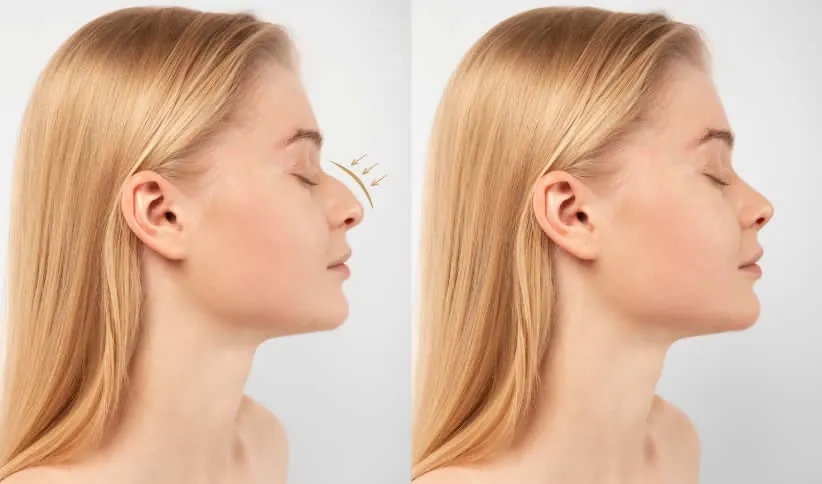
After a rhinoplasty, people usually return to social life in 1 or 2 weeks, but the nose needs more time: complete deflation can take between 6 and 12 months, especially in the tip. It is not usually a particularly painful recovery, but it requires rest, specific care and patience.
Rhinoplasty recovery is usually easier than many people imagine, but it requires patience. It is not a surgery known for intense pain: the most uncomfortable aspects are the swelling, the congestion, the splint, the bruising and the feeling of not yet looking “as you expected” during the first weeks. In this guide we explain the phases of recovery week by week, when the swelling goes down, when the final result can be seen, what care to follow, what to avoid and what the warning signs are.
It helps to think of recovery from Rhinoplasty in Girona in two phases: a short first stage, in which you aim to look presentable, and a longer second one, in which the nose is gradually refined until it approaches the final result.
How long does rhinoplasty recovery take
In practice, it is usual to return to a relatively normal social life within 1 or 2 weeks, as long as recovery is going well and the surgeon authorises it. That does not mean the nose is fully recovered: complete deflation can take between 6 and 12 months, especially at the tip, which is the slowest area to take shape. Recovery does not end when the splint is removed; that is usually just the first big step.
Rhinoplasty recovery by phases (week by week)
| Moment | What usually happens |
|---|---|
| First 24-48 hours | Inflammation, congestion, rest and possible slight bleeding |
| First week | Splint, bruising, blocked nose and basic care |
| 7-10 days | Usual removal of the splint, as medically indicated |
| 1-2 semanas | Gradual return to social life or non-physical work |
| 3-4 semanas | More comfort, less visible swelling and light activity |
| 2-3 meses | A more defined nose, although still with some swelling |
| 6-12 months | More stable result and more complete deflation of swelling |
The most obvious swelling improves a great deal during the first weeks, but the nose keeps changing for months. Comparing the final result with what you see at 10 days is a common mistake: the fact that the nose looks swollen at first does not mean the result is bad.
First 24-48 hours
They are days of rest. It is normal to feel a congested nose, pressure in the face, swelling and minor discomfort; there may be slight bleeding on the first day. What matters: rest, keep your head elevated, do not touch your nose, follow the medication, avoid exertion, do not bend down suddenly and do not blow your nose.
First and second week
During the first week a splint is worn; bruising around the eyes and facial swelling may appear. It is the least favourable moment of the process: it is best not to draw conclusions. In the second week many people already feel more comfortable and, if the splint is removed, a first idea of the new shape appears. This is where the gradual return to social life begins, avoiding intense sport, knocks, heavy glasses and direct sun.
From the first month to 6-12 months
During the first month you need to be cautious: the nose is more stable but not fully recovered. Between 3 and 6 months it usually looks much more natural, although some oedema may remain at the tip. Between 6 and 12 months the final result can be better judged; in thick skin or secondary rhinoplasties the process may be slower.
Does recovery from rhinoplasty hurt?
In general it is not an especially painful surgery. Most patients describe it more as pressure, congestion, tightness or discomfort. The blocked-nose sensation is usually the most bothersome and improves progressively; nasal rinses and medical guidelines are key. Bruising around the eyes may appear and usually improves in the first or second week.
Rhinoplasty recovery, day by day
Many people want to know what rhinoplasty recovery is like day by day, because seeing the process broken down is reassuring and helps with planning. Below we describe an approximate progression: every patient heals at their own pace and your surgeon will always set the specific guidelines. The key is to understand that discomfort is greatest at the beginning and fades quickly, while the aesthetic side is refined slowly.
Day 1: the day of surgery
When you wake up from the anaesthesia you will notice a blocked nose, some pressure in your face and perhaps a small dressing under the nostrils to catch any dripping (known as a «moustache»). Slight bleeding in the first few hours is normal. You are advised to rest with your head raised, not to bend down, not to make any effort and to take the prescribed medication (painkillers and, if appropriate, antibiotics). You should drink fluids and gradually eat something soft and lukewarm once the dizziness goes away. You must not blow your nose or touch the splint.
Days 2 and 3: peak of swelling
Facial swelling and bruising around the eyes usually peak between the second and third day; it may seem that you are "getting worse" when in fact it is the expected evolution. Local cold (as instructed, without resting it on the splint) helps it go down. Relative rest is maintained, with the head elevated also for sleeping, and saline washes if the team has already prescribed them. It is common to feel the nose very congested because there is also swelling inside.
Days 4 to 6: improvement begins
From the fourth day, most people notice that the swelling stops increasing and the bruises begin to change color (from purple to yellowish), a sign that they are being reabsorbed. Many people already manage well at home, read, do light tasks at the computer and walk around the house. You should still avoid bending over, lifting weight and any effort that raises pressure in the face.
Days 7 to 10: splint removal
It is one of the most anticipated moments: the splint is usually removed between day 7 and 10, always at the doctor's discretion. When it comes off you will see a nose that is still swollen and perhaps "wide" or "upturned": this is not the final result. External stitches may also be removed if there are any. From here, social life resumes gradually; it is advisable to protect yourself from the sun and avoid glasses that rest on the bridge.
Recovery, week by week
First week: with a splint
It is the least pleasant phase: you are wearing the splint, your nose is blocked, there is bruising and your face looks swollen. It is the worst time to judge the result. The keys are resting, sleeping on your back with your head elevated, doing the nasal rinses, not blowing your nose and avoiding exertion. If you work from home on something non-physical, many people can resume light tasks around day 4-5, but it is best to reserve this week for recovering.
Second week: without a splint, back to social life
Once the splint is removed, the most noticeable swelling goes down and the bruises usually disappear or can be hidden with makeup. This is when many people return to office work and to a normal social life. Sport, knocks, intense sun, the sauna and bending your head down for long are still avoided. The nose remains slightly swollen, especially in the morning when you get up, which is completely normal.
Third and fourth week: first month
During the first month the nose gains definition and most of the visible swelling has gone down, although some oedema persists that you notice more than others do. Gentle exercise (brisk walking, light stationary cycling) is usually allowed depending on progress, but no impact or strenuous activity. It is a good time to resume your routine normally, taking care with sun protection to avoid marks on the healing skin.
From 2-3 months onwards
Between the second and third month the nose already looks quite natural in everyday photos; the residual swelling is concentrated in the tip. From here on, higher-intensity sport is usually allowed again progressively. Many patients say that “nobody notices anymore that they had surgery”, although they themselves keep noticing small changes month by month.
Up to ~1 year: the result of the tip
The final result is consolidated between 6 and 12 months, and in thick skin or secondary rhinoplasties it can take close to a year or somewhat longer. The last thing to settle is the nasal tip, which gradually loses its swelling until it shows its final shape. That is why honest “before and after” comparisons are made from one year onwards.
Practical questions for everyday life
How should I sleep after rhinoplasty?
On your back with your head raised (with two pillows or by raising the headboard) for at least the first 2-3 weeks. Sleeping this way reduces swelling and prevents accidental pressure on the nose. You must avoid sleeping on your side or face down until your surgeon authorises it, because the pressure can displace structures that are still fragile. If you move a lot in your sleep, placing pillows at your sides helps keep the position.
When can I blow my nose?
You must not blow your nose hard during the first weeks (approximately 2-3 weeks, as directed): the pressure can promote bleeding and affect internal healing. For congestion, the solution is saline rinses and, if you sneeze, do so with your mouth open to avoid creating pressure in the nasal passages. When your surgeon allows it, you will be able to blow your nose gently, one side first and then the other.
What can I eat during recovery?
In the first few days a soft, lukewarm diet is advisable, avoiding very hot foods (heat dilates the blood vessels and may increase bleeding) and very hard foods or those that require opening your mouth wide. Stay well hydrated and prioritise a diet rich in fruit, vegetables and protein, which promotes healing. It is advisable to avoid alcohol in the first few weeks because it promotes swelling and may interfere with medication, and not to smoke, since tobacco reduces blood flow and hinders healing.
When can I go back to work?
It depends on the type of job. In office or remote jobs, many people return around the second week, once the splint has been removed and the bruising has been concealed. In physical jobs, involving effort or risk of knocks, more time is usually needed (several weeks) and always with medical authorisation. If your job involves direct sun, dust or stuffy environments, mention it at the consultation so the return can be adapted.
When can I play sports or exercise?
Sport is reintroduced gradually. Gentle walking is usually allowed early on; light aerobic exercise is usually permitted again at around 3-4 weeks; and intense, strength or contact sports (padel, football, martial arts, heavy weights) usually have to wait between 6 weeks and 2-3 months, depending on progress and the surgeon's judgment, because of the risk of knocks and of raising pressure in the face. Swimming and diving are also postponed because of the risk of infection and pressure.
Swelling, fibrosis and bony callus: what they are and how long they last
How long does swelling of the tip of the nose last?
Swelling of the tip is the most persistent of the whole recovery. Most of it goes down in the first weeks, but a slight oedema can remain for months and not disappear completely until 6-12 months (sometimes up to well over a year in thick skin). It is normal to feel the tip “harder”, slightly raised or less mobile during this time; it is also common to find it more swollen in the morning than at night. Patience is essential here: the tip is the last thing to take shape.
How do I know if I have fibrosis?
Fibrosis is scar tissue that can form under the skin, especially at the tip and in thick skin, and is perceived as an area that is more hardened, thickened or bulging and slow to subside. It is not the same as normal swelling: fibrosis is more localised and persistent. Only a surgeon can confirm it at a check-up. If it appears, the team itself assesses how to manage it, which may include prescribed massage, specific measures or, in selected cases, injections; you should never self-medicate or massage your nose on your own without being told to.
What is a bone callus and how is it treated?
After remodelling the nasal bone, a small bony callus may form in some cases: an excess of bone tissue in the treated area that is felt as a small bump or irregularity on the dorsum. It is usually assessed after several months, once the healing process has stabilised. Depending on the case, it may need nothing, be treated with conservative measures or, if it bothers you aesthetically and persists, a touch-up may be considered. As always, the right course of action is decided by the surgeon after examining you; techniques that are gentler on the bone, such as Ultrasound rhinoplasty, aim precisely to minimise this type of irregularity.
Bruising, nasal packing and splint
Bruising around the eyes
Bruising on the eyelids and under the eyes is very common, especially when the bone is worked on, and does not mean that something is going wrong. It appears in the first 48-72 hours, changes colour as it is reabsorbed and usually disappears between the first and second week. Local cold in the first days, sleeping with your head raised and avoiding exertion help it go away sooner. From the second week, if any tone remains, it can usually be easily concealed with corrective make-up.
Nasal obstruction and congestion
Having a blocked nose is among the most annoying and the most normal things: there is internal swelling and, at times, crusts or small plugs. In some techniques, nasal packing or silicone sheets (splints) are placed inside and removed at the clinic a few days later. Breathing improves progressively as the swelling goes down; saline rinses are key to keeping the nasal passages clean. Feeling your nose "stuffed up" for weeks is to be expected and should not alarm you.
When is the splint removed?
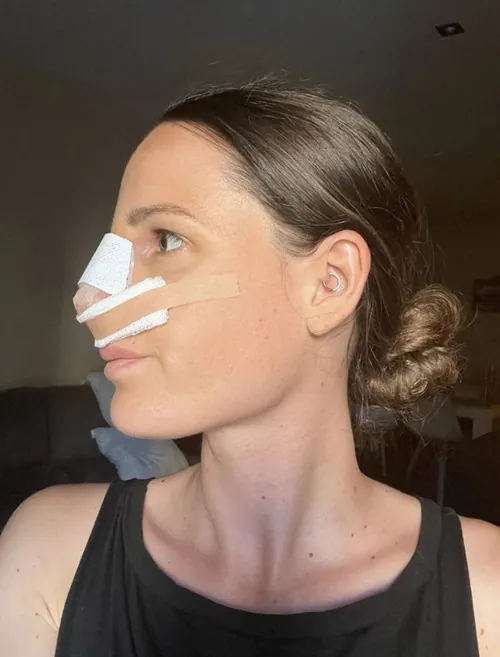
The external splint (the plaster or plastic that protects the nose and holds its shape) is usually removed between day 7 and 10, depending on the technique and the surgeon's judgement. You must not wet it, press on it or try to remove it yourself. When it is removed, the nose will be swollen and it is normal not to fully recognise yourself: it is an intermediate picture, not the result. In some cases a small piece of tape (taping) is applied for a few days to help control the swelling.
When is the final result of rhinoplasty visible?
This is one of the biggest questions and also the one that causes the most anxiety. The honest answer: the essentials of the shape can be seen within a few weeks, but the final result takes between 6 and 12 months, and the tip may need up to almost a year. What you see when the splint comes off (day 7-10) is a swollen nose; after a month it already looks much more natural; by 3 months most of the swelling has gone; and from 6-12 months onwards the nose shows its real shape. Comparing your nose at 10 days with the «before» photo makes no sense: the brain needs time to get used to it and the nose needs time to settle down. If you have had a second operation or have thick skin, allow yourself more leeway.
Tips for a good recovery
Beyond what the surgeon does in the operating room, your behaviour at home has a big influence on how you progress. These habits help make recovery more comfortable and protect the result:
- Be strict with the medical guidelines and attend all check-ups: follow-up is part of the treatment.
- Sleep on your back with your head raised for the first few weeks and arrange the bedroom so you don't turn over by accident.
- Do the nasal rinses with saline solution as instructed; keeping the nostrils clean improves the sensation of breathing.
- Protect your nose from the sun with high sun protection for months, to avoid blemishes on the healing skin.
- Be careful with glasses: avoid resting them on the bridge until the surgeon authorises it; there are tricks to hold them on your forehead if you need them.
- Do not smoke or drink alcohol in the initial phase: tobacco compromises healing and alcohol increases swelling.
- Be patient with the tip: it is the last thing to take shape; do not judge the result too early.
- Avoid knocks (contact sports, children, pets) and concentrate your rest in the first few days.
Care after a rhinoplasty
- Sleep on your back with your head raised for the first few days, to reduce swelling and avoid pressure on the nose.
- Apply local cold as medically indicated, without pressing on the bridge or placing it over the splint.
- Nasal rinses with saline solution when the surgeon indicates and in the correct way.
- Avoid glasses, knocks and pressure on the nose; be careful with children, pets and sudden hugs.
- Avoid intense exercise at first; gentle walking is usually allowed sooner.
- Protect yourself from the sun with sunscreen, avoiding direct exposure in the initial phase.
What not to do during recovery
- Do not blow your nose hard.
- Do not smoke or drink alcohol during the initial phase (they affect healing).
- Do not exercise too soon.
- No tocar ni manipular la férula.
- Don’t obsess over the result in the first few days: the nose is swollen and adapting.
For an extended list of post-operative recommendations, see also how to take care of yourself after a rhinoplasty.
Recovery depending on the type of nasal treatment
Not all treatments have the same recovery. Ultrasound rhinoplasty allows the bone to be worked on more precisely and the post-operative period can be easier, but it is still surgery with swelling times. Rhinomodelling (without surgery) has a faster recovery, but it does not replace rhinoplasty when bone, cartilage or function need to be modified. The choice should not be made on recovery alone, but on what your nose really needs.
| Treatment | Recovery | What it can improve |
|---|---|---|
| Rinoplastia quirúrgica | Longer, with swelling and a splint | Shape, structure, tip, bridge and, in some cases, function |
| Ultrasonic rhinoplasty | Similar, with a more precise technique on the bone | Structural changes with a surgical approach |
| Rhinomodelling | Faster, without surgery | Minor irregularities or targeted harmonisation |
Warning signs and when to call the doctor
The vast majority of recoveries progress without incident, but it is worth knowing how to tell what is expected from what requires a consultation. It is normal to have: swelling, bruising, congestion, slight bleeding on the first day, discomfort that can be controlled with medication and a hard or raised tip for weeks. You should contact the medical team if any of these signs appear:
- Heavy bleeding or bleeding that does not stop with rest and head elevation, or that returns strongly after the first few days.
- Fever (usually above 38 °C) or signs of infection: intense redness that increases, local warmth, foul-smelling discharge or pus.
- Intense and increasing pain that does not improve with the prescribed medication, especially if asymmetrical or throbbing.
- Sudden swelling on one side, a lump that grows quickly or a very tense and painful area (it could indicate a haematoma that needs treatment).
- A blow or trauma to the nose during the postoperative period, even if it seems mild.
- Visual problems, significant eye pain or changes around the eyes that worry you.
- Breathing difficulty that gets worse instead of better, or general malaise.
When in doubt, it is always better to ask: a call in time resolves most doubts and allows you to act early if necessary. Keep the clinic's contact number handy during the first few weeks. Good postoperative follow-up makes it possible to check the splint, control the swelling and monitor the evolution of the result: surgery does not end when you leave the operating room.
Keys to living the recovery with peace of mind
Recovering from a rhinoplasty takes more patience than it involves pain. It will help to remember that:
- Social life can usually resume within 1-2 weeks, but the result takes 6-12 months.
- The nasal tip is the last to go down in swelling, especially in thick skin.
- Follow-up and check-ups are part of the treatment.
If you understand that recovery happens in stages, it will be much easier. Doubts about your case? Visit the Rhinoplasty Unit in Girona →
Resolve your case with the medical team
First consultation for aesthetic and functional nose surgery, in Girona.
Related video
Ultrasonic rhinoplasty in Girona: precision and recovery · Watch on our YouTube channel
Frequently asked questions
When can I go outside after a rhinoplasty?
When will they remove my splint?
When can I sleep on my side?
When can I exercise?
How long does it take for swelling of the nasal tip to go down?
Is rhinoplasty recovery very painful?
How should I sleep after rhinoplasty?
When can I blow my nose?
What can I eat during recovery?
When can I go back to work?
How do I know if I have fibrosis in the tip?
What is a bone callus and how is it treated?
How long do bruises around the eyes last?
When is the final result of rhinoplasty visible?
When should I call the doctor during recovery?
Treatments and related units
Explore the treatments for Facial Cosmetic Surgery Unit and other areas of the clinic. Filter by area:
Rhinoplasty in Girona
Aesthetic and functional nose surgery, also with the ultrasonic technique.
Neck and jowl mini lift
Neck and double chin treatment with less surgical aggression.
Related articles
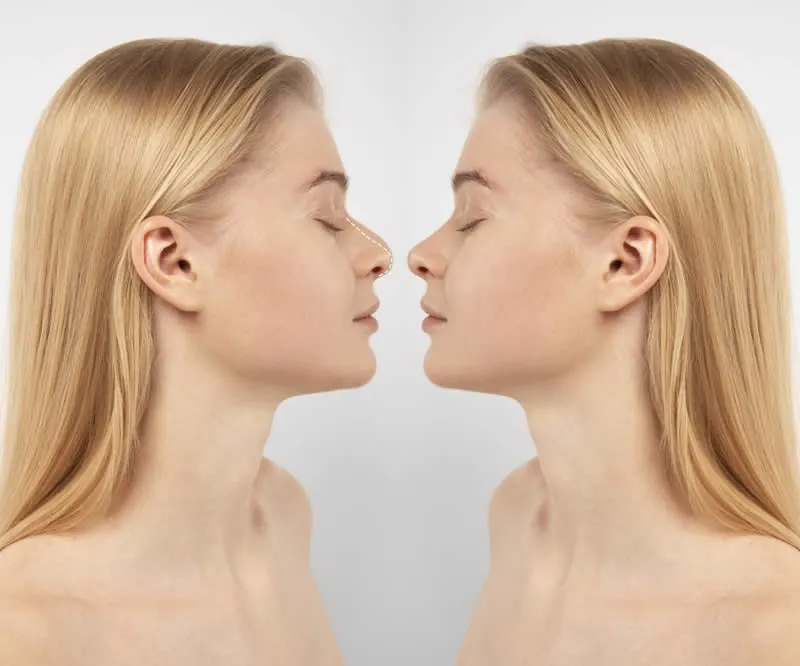

We serve patients from all over the province of Girona
Our clinic is located in the centre of Girona (Plaça Poeta Marquina, 3) and we regularly see patients from the city and the entire surrounding area and the Costa Brava. If you are coming from further afield, we coordinate appointments to group assessments and tests on the same day.
Plaça Poeta Marquina, 3, 17002 Girona · easy access from the AP-7 and N-II · How to get there and opening times
Medical review Content created by the medical team at Medics Integral Salut and reviewed by the Facial Aesthetic Surgery Unit.
Sources and references: Spanish Society of Plastic, Reconstructive and Aesthetic Surgery (SECPRE) · Spanish Society of Otorhinolaryngology and Head and Neck Surgery (SEORL-CCC).